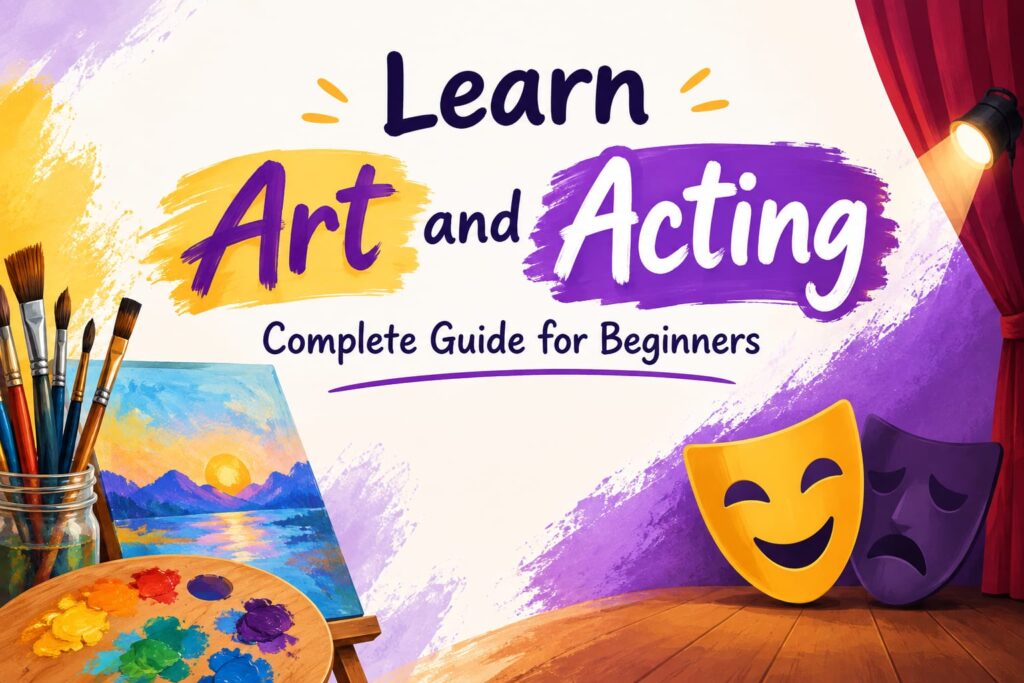
LEARN ART AND ACTING: A COMPLETE GUIDE FOR BEGINNERS
Art and acting are powerful forms of creative expression. They help us communicate ideas, express emotions, build confidence and discover our imagination. You do not need to be an expert to start learning art or acting. With regular practice, proper guidance and a willingness to learn, anyone can develop creative skills.
If you are a beginner who wants to learn art, acting or both, this guide will help you understand where to start and how to improve your skills step by step.
WHY SHOULD YOU LEARN ART AND ACTING?
Art and acting are not only about becoming a professional artist or actor. They can also help you develop important personal skills.
Learning art can improve observation, concentration, imagination and patience. Acting can improve communication, body language, confidence and presentation skills.
Both creative fields encourage you to think differently and express your ideas.
Whether you are a school student, college student, working professional or simply someone interested in creativity, learning art and acting can become an enjoyable and meaningful journey.
HOW TO START LEARNING ART
The best way to learn art is to start with the basics. You do not need expensive materials or a professional studio when you are beginning.
Start with simple drawing exercises. Practice lines, circles, shapes and basic objects. Gradually move towards sketching people, nature, objects and surroundings.
Observation is one of the most important skills for an artist. Spend time looking carefully at the things around you. Notice shapes, proportions, light, shadows, colours and details.
As your confidence improves, you can explore different mediums such as:
• Pencil and charcoal
• Watercolours
• Acrylic colours
• Poster colours
• Oil colours
• Mixed media
You can also explore different styles of art and learn about traditional and contemporary art forms.
THE IMPORTANCE OF REGULAR ART PRACTICE
Many beginners expect their artwork to look perfect immediately. This can lead to frustration.
Art is a skill that develops through practice.
Even 20 to 30 minutes of regular drawing or painting can help you improve over time. Instead of comparing your work with professional artists, compare your current work with your previous work.
Keep your old drawings and paintings. After a few months, you may be surprised to see how much you have improved.
HOW TO START LEARNING ACTING
Acting beginners can start with simple exercises that develop voice, expression, movement and confidence.
One useful exercise is reading a short passage aloud. Focus on pronunciation, clarity, voice modulation and emotion.
You can also practice different facial expressions in front of a mirror. Try expressing happiness, sadness, anger, surprise and fear without speaking.
Body language is another important part of acting. Your posture, hand movements, eye contact and walking style can communicate emotions even before you speak.
As you become comfortable with basic exercises, start performing short scenes or monologues.
UNDERSTANDING VOICE AND DIALOGUE DELIVERY
A good actor needs to understand how to use their voice effectively.
The same sentence can have different meanings depending on tone, speed, volume and emotion.
When practicing dialogue, avoid speaking every line in the same way. Understand what the character is feeling and why the character is saying those words.
Practice speaking clearly without rushing.
Recording yourself on a phone can also be useful. When you watch the recording, you can notice areas where your pronunciation, expressions, body language or timing can improve.
HOW ACTING BUILDS CONFIDENCE
Many people feel nervous when speaking in front of others. Acting exercises can provide a safe way to overcome this fear.
Performing a short scene or monologue encourages you to stand in front of an audience and communicate with confidence.
With regular practice, you may become more comfortable speaking in classrooms, meetings, presentations and public situations.
Acting also teaches you to listen to other performers and work as part of a team.
COMBINING ART AND ACTING
Art and acting may appear to be different creative fields, but they have many similarities.
Both require imagination, observation and self-expression.
An artist communicates through colours, lines, shapes and compositions. An actor communicates through voice, movement, expressions and character.
Learning both can help you develop a broader understanding of creativity.
For example, an artist can use storytelling to create meaningful paintings, while an actor can use visual observation to understand characters and environments.
TIPS FOR BEGINNERS
If you are starting your creative journey, keep these simple tips in mind:
- START WITH THE BASICS
Do not try to learn everything at once. Build your skills step by step.
- PRACTICE REGULARLY
Consistent practice is more useful than practicing only occasionally.
- DO NOT FEAR MISTAKES
Mistakes are a natural part of learning. Use them as opportunities to improve.
- OBSERVE PEOPLE AND THE WORLD
Observation is valuable for both artists and actors. Look carefully at people, nature, expressions, movement and everyday situations.
- LEARN FROM EXPERIENCED TEACHERS
A good teacher can help you understand techniques, correct mistakes and develop your individual style.
- EXPERIMENT
Try different art materials, acting exercises, characters and creative ideas. Experimentation can help you discover what you enjoy.
- ENJOY THE PROCESS
Learning art and acting should not always be about results. Enjoy creating, performing and discovering new skills.
CAN BEGINNERS LEARN ART AND ACTING ONLINE?
Yes. Online learning has made creative education more accessible.
Beginners can learn through online classes, instructional videos, demonstrations and practice exercises. However, when possible, personal guidance from an experienced teacher can provide additional benefits, especially for developing practical skills.
The most important thing is to choose reliable learning resources and practice what you learn.
BUILD YOUR CREATIVE JOURNEY WITH ART N ACTING
Learning art and acting can be the beginning of an exciting creative journey.
At Art N Acting, the focus is on encouraging learners to explore their creativity through art education and acting training. Whether you want to improve your drawing skills, explore painting, develop acting abilities or simply become more confident in expressing yourself, creative learning can help you take the first step.
You do not have to wait until you feel talented. Start where you are, learn the fundamentals and keep practicing.
CONCLUSION
Learning art and acting is a journey rather than a destination. You may make mistakes, discover new interests and change your creative style along the way.
Start with simple exercises. Practice regularly. Observe the world around you. Learn from experienced teachers and, most importantly, enjoy the process.
Whether your goal is to become an artist, actor, teacher, performer or simply a more creative person, the first step is to begin.
Your creativity is waiting to be explored. Start learning today.