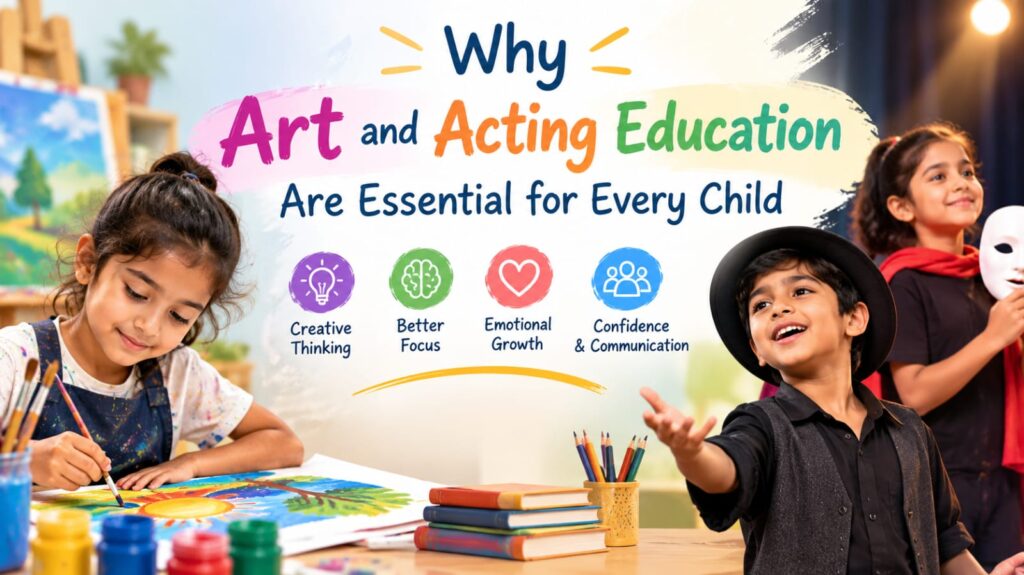
Why Art and Acting Education Are Essential for Every Child
Is Artistic Talent a Gift from Birth?
Many people believe that becoming an artist is a special gift that only a few people are born with. They assume that artistic talent is something given at birth and that only naturally gifted individuals can become successful artists.
However, this is one of the biggest misconceptions about art education.
Just as children learn a language by first learning the alphabet, then words, sentences, and eventually complete paragraphs, art can also be learned through a systematic process. Reading, writing, mathematics, science, and other academic subjects are all skills that develop through learning and practice. Art is no different.
While some individuals may show a natural interest or aptitude for art, every child can learn the fundamental skills of drawing, painting, and visual expression through proper guidance and regular practice.
Art Has Its Own Alphabet
Every language has an alphabet. Similarly, art has its own visual language known as the Elements of Art.
These seven fundamental elements are:
- Line
- Shape
- Color
- Form
- Texture
- Value
- Space
These elements serve as the building blocks of all visual art.
For example, when children begin learning about lines, they practice different types such as:
- Vertical lines
- Horizontal lines
- Diagonal lines
- Zigzag lines
- Curved lines
- Wavy lines
As they gain confidence with these basic elements, they gradually learn how to create shapes, objects, landscapes, and complete artworks.
The same process applies to color, form, texture, value, and space. Through consistent practice, children develop the ability to express their thoughts, ideas, and emotions visually.
Different Levels of Artistic Development
Just as every person who learns a language does not become a poet, novelist, or songwriter, every child who learns art may not become a professional artist.
However, learning art gives everyone the ability to observe, create, communicate, and express themselves visually.
Some artists become skilled at drawing objects exactly as they appear.
Others become excellent at recreating artworks by observation.
Some develop advanced creative thinking and produce original artworks based on their imagination and emotions.
The level of artistic achievement depends on factors such as dedication, observation, creativity, practice, and personal interest.
The important point is that art is a learnable skill, and every child can benefit from learning it.
Why Art Education Matters Beyond Drawing
Many parents want their children to excel academically. This is completely understandable because education plays a vital role in shaping a child’s future.
As a result, some parents view activities such as drawing, painting, acting, music, dance, and creative arts as optional rather than essential.
However, modern educational research suggests that creative learning experiences contribute significantly to a child’s overall development.
Art education is not only about creating beautiful pictures. It helps children develop skills that support learning across many areas of life.
Why Children Can Watch a Movie for Three Hours but Struggle to Study for Thirty Minutes
Consider a common observation.
Many children find it difficult to remain focused on an academic subject for a long period of time. After 20 to 40 minutes of studying, they often become tired or distracted.
Yet the same children can watch a three-hour movie with complete attention and remember most of the story afterward.
Why does this happen?
The answer lies in interest, engagement, and the way the brain processes different experiences.
Children naturally focus longer on activities that stimulate their imagination, emotions, curiosity, and creativity. When learning becomes engaging and enjoyable, attention improves significantly.
This is one of the reasons why creative subjects such as art and acting are so valuable.
How Art Supports Brain Development
The human brain benefits from a balance between analytical thinking and creative thinking.
Academic subjects such as mathematics and science help develop reasoning, analysis, and problem-solving abilities.
Creative activities such as drawing, painting, storytelling, acting, music, and design strengthen imagination, visual thinking, innovation, and self-expression.
When children participate in both academic and creative activities, they develop a more balanced set of cognitive skills.
Art education encourages children to:
- Think creatively
- Observe carefully
- Solve problems visually
- Explore new ideas
- Express emotions constructively
- Build confidence in their abilities
These skills support not only artistic growth but also academic success and lifelong learning.
How Art Improves Academic Performance
Many parents are surprised to learn that art can actually help children perform better in school.
After spending a long time studying academic subjects, children often experience mental fatigue. A short creative activity such as drawing, painting, acting, or music can refresh their minds and restore motivation.
When students return to their studies after a creative break, they often feel more focused and ready to learn.
Art education helps improve:
- Concentration
- Memory retention
- Observation skills
- Visual thinking
- Problem-solving abilities
- Creativity
- Self-confidence
- Emotional intelligence
- Communication skills
These abilities can positively influence performance in many academic subjects.
The Hidden Benefits of Art Education
One of the most remarkable aspects of art education is that many of its benefits are invisible.
Parents can easily see improvements in examination scores and report cards. However, it is much harder to measure qualities such as imagination, confidence, resilience, creativity, and emotional expression.
Through regular artistic practice, children gradually develop:
- Patience
- Discipline
- Focus
- Perseverance
- Self-expression
- Confidence
- Innovation
- Independent thinking
These qualities continue to benefit them throughout their education, careers, businesses, and personal lives.
The results may not always appear immediately, but they often become visible as children grow into capable and successful adults.
Why Acting Education Is Equally Important
Acting is much more than performing on a stage.
Acting helps children:
- Improve communication skills
- Develop self-confidence
- Overcome stage fear
- Strengthen public speaking abilities
- Enhance emotional awareness
- Improve teamwork and collaboration
- Build leadership qualities
These skills are valuable in every profession, whether a child becomes an artist, engineer, doctor, teacher, entrepreneur, or business leader.
Every Child Deserves Creative Education
Art and acting should not be viewed as extracurricular activities alone.
They are essential components of a well-rounded education.
Children need opportunities not only to memorize information but also to imagine, create, communicate, and express themselves.
When academic learning is combined with art and acting education, children become more confident, creative, focused, and capable individuals.
Conclusion
The belief that artistic ability is only for a gifted few is a myth.
Just as anyone can learn to read and write by mastering the alphabet, anyone can learn art by understanding and practicing its fundamental elements.
Art education develops creativity, concentration, observation, confidence, communication skills, and emotional intelligence. Acting education further strengthens self-expression, leadership, and public speaking abilities.
Together, art and acting help children achieve balanced growth and prepare them for success in school, career, and life.
That is why every child deserves the opportunity to learn, practice, and experience the transformative power of art and acting education