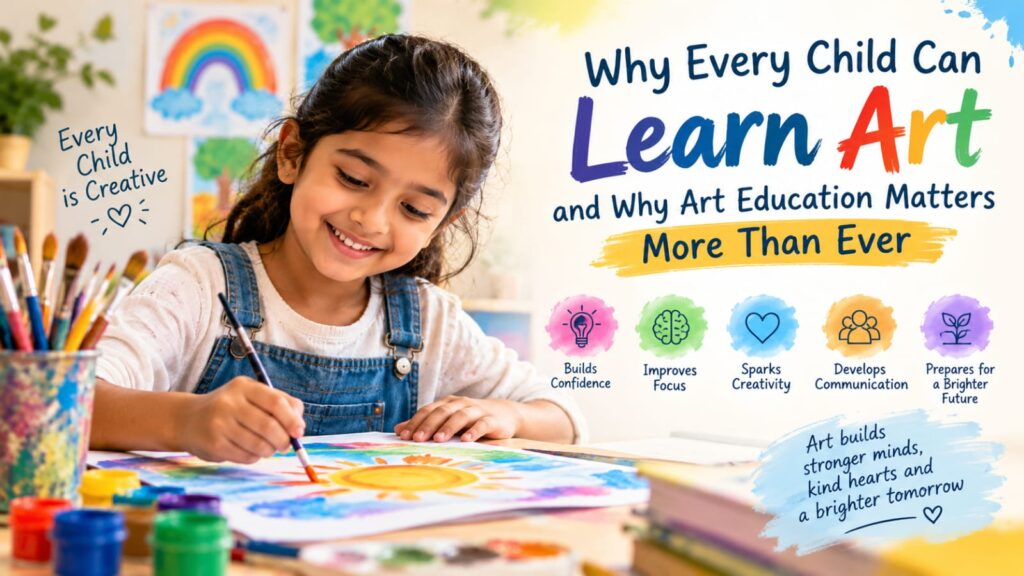
Why Every Child Can Learn Art and Why Art Education Matters More Than Ever
Many people believe that becoming an artist is a gift that only a few fortunate individuals are born with. They think artistic talent is something granted by God at birth and that only naturally gifted people can become successful artists. As a result, many assume that practicing art alone cannot make someone an artist.
However, this belief is far from the truth.
Think about how we learn a language. A child begins by learning the alphabet. Letters become words, words become sentences, and sentences become paragraphs. Through continuous learning and practice, anyone can learn to read, write, and communicate effectively.
The same principle applies to every academic subject. Whether it is Mathematics, Science, Social Studies, or Physics, students develop knowledge and skills through systematic learning and regular practice.
Art works in exactly the same way.
Art Has Its Own Alphabet
Just as language has alphabets, art also has its own visual alphabet. These are known as the Seven Elements of Art:
- Line
- Shape
- Color
- Form
- Texture
- Value
- Space
These elements form the foundation of all artistic creation.
For example, let us consider the element of Line. A student can learn different types of lines such as:
- Vertical lines
- Horizontal lines
- Zigzag lines
- Wavy lines
- Diagonal lines
- Curved lines
When children practice drawing these basic lines repeatedly, they gradually develop the ability to draw more complex shapes and objects. Over time, they gain confidence and artistic skills that enable them to create drawings and paintings of increasing quality.
Similarly, by learning and practicing color, shape, texture, value, and space, students develop a deeper understanding of visual expression. With consistent practice, they become capable of transforming their thoughts, feelings, and imagination into meaningful works of art.
Different Levels of Artistic Creativity
Not everyone develops artistic skills in the same way.
Some people become skilled at drawing objects exactly as they see them.
Others can reproduce artworks by observing and studying existing images.
Some individuals go a step further and create entirely original artworks based on ideas, emotions, and concepts from their imagination.
These differences are influenced by each person’s level of creativity, observation, imagination, and dedication to practice.
Just as every person who learns a language does not become a poet, novelist, or songwriter, every person who learns art may not become a professional artist. However, they can still develop the ability to draw, create, express ideas visually, and appreciate art.
That alone is an incredibly valuable skill.
The Hidden Benefits of Learning Art
When parents think about their children’s future, they naturally want them to achieve high academic success. Most parents encourage their children to focus heavily on school subjects because education helps build a successful career and future.
At the same time, many parents view activities such as drawing, painting, acting, dance, music, and other creative pursuits as secondary activities with limited long-term value.
But research and real-world experience suggest a different perspective.
Art education provides powerful benefits that extend far beyond creating beautiful drawings.
Why Children Lose Focus While Studying
Consider this common situation.
Many students struggle to concentrate on academic subjects for more than 20 to 40 minutes at a time. They become tired, distracted, or bored.
However, the same children can watch a three-hour movie with complete focus and attention. After the movie ends, they can often describe the entire story, scene by scene, without missing important details.
Why does this happen?
If children have the ability to focus intensely on something they enjoy, why do they find it difficult to maintain the same concentration while studying?
The answer lies partly in how the brain processes different types of activities.
The Importance of Balancing the Brain
The human brain is often described as having two complementary modes of functioning.
Left-Brain Functions
The left side is commonly associated with:
- Logical thinking
- Analysis
- Calculations
- Reasoning
- Facts and information
- Problem-solving
These functions are heavily involved in academic learning.
Right-Brain Functions
The right side is commonly associated with:
- Creativity
- Imagination
- Visual thinking
- Artistic expression
- Music and rhythm
- Emotional connection
Creative activities such as drawing, painting, acting, storytelling, music, and dance engage these abilities.
For children to develop into well-rounded individuals, both creative and analytical skills need opportunities to grow.
How Art Supports Academic Success
When children spend a long period studying academic subjects, mental fatigue can occur. Their attention gradually decreases, and learning becomes less effective.
At this point, engaging in a creative activity can be extremely beneficial.
A short drawing session, a few minutes of acting, singing, painting, or another creative exercise allows the mind to shift into a different mode of thinking. This change helps refresh attention and restore mental energy.
After participating in creative activities, many children return to their studies feeling more focused, motivated, and ready to learn.
In this way, art education does not compete with academic learning—it supports it.
Art helps students:
- Improve concentration
- Strengthen observation skills
- Enhance memory retention
- Develop problem-solving abilities
- Build confidence
- Improve emotional well-being
- Increase creative thinking
- Reduce stress and mental fatigue
These benefits contribute directly to better learning outcomes in school.
The Invisible Growth That Art Creates
One of the most remarkable aspects of art education is that many of its benefits are not immediately visible.
Parents can easily measure test scores, grades, and academic performance. These results appear clearly on report cards.
However, the internal growth that occurs through art education is much harder to measure.
Through regular artistic practice, children gradually develop:
- Patience
- Discipline
- Focus
- Visual intelligence
- Creative thinking
- Emotional expression
- Self-confidence
- Imagination
- Decision-making skills
These qualities become powerful assets throughout life.
As children grow into adults, these abilities help them succeed not only in creative careers but also in business, leadership, entrepreneurship, communication, and professional life.
The impact of art education often reveals itself years later through improved confidence, innovation, adaptability, and problem-solving abilities.
Why Art and Acting Should Be Part of Every Child’s Education
Art and acting are not merely hobbies or recreational activities. They are powerful educational tools that contribute to a child’s overall development.
When combined with academic learning, they help children become more balanced, creative, confident, and capable individuals.
Every child deserves the opportunity to explore creativity, express emotions, develop imagination, and discover their unique talents.
Whether a child becomes a professional artist, actor, engineer, teacher, doctor, entrepreneur, or scientist, the skills gained through art and acting can positively influence every aspect of life.
Conclusion
The belief that only naturally gifted people can become artists is a misconception. Just as anyone can learn to read and write by mastering the alphabet, anyone can learn art by understanding and practicing its basic elements.
Art is a learnable skill.
More importantly, art education offers benefits that extend far beyond artistic ability. It strengthens concentration, creativity, emotional intelligence, confidence, and lifelong learning skills.
For this reason, art and acting should be considered essential parts of a child’s education, helping them grow not only as students but also as imaginative, capable, and successful human beings.